
THE IMPORTANCE OF CHOOSING THE CORRECT FILM WIDTH
Film width requirements can vary greatly depending on the substrate width, lamination method, and application. For printers who produce a range of product types, it is especially important to understand how different print applications affect the film to substrate ratio. This guide will cover the most common types of lamination and explain how to choose a film that fits your substrate.
GENERAL COMMERCIAL PRINT
In thermal lamination, it is important to ensure the adhesive side of the laminate does not touch the rollers as this can result in expensive and time-consuming damage. Sheet-fed thermal laminators can be used for a wide range of applications, but the general guidelines for lamination depend chiefly on whether the print is laminated on one or both sides. Let’s look at each option to explain how film width recommendations differ.
Single-Sided Lamination
For single-sided prints, the laminate web should be narrower than the substrate but wider than the printed image. This ensures the thermal adhesive never makes contact with the laminator’s rollers while still providing complete coverage for the finished print.
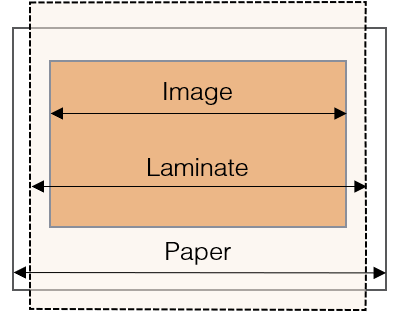
Below are some common substrate sizes and the corresponding recommended laminate width. As a general rule of thumb, the laminate web should be 0.25 to 0.50 inches narrower than the substrate width.

Double-Sided Lamination
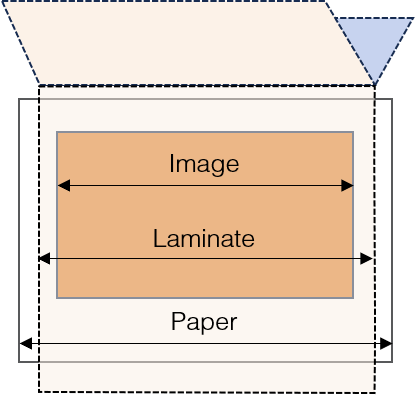
Two-sided lamination where the edges of the finished print are cut flush with the laminate mostly follow the same guidelines as a single-sided print. Ensure the laminate web is narrower than the substrate but wider than the printed image. When the sheets are trimmed down after lamination, the film edges will sit flush with the substrate while providing protection to both sides of the sheet. The laminate should usually be 0.25 or 0.50 inches narrower than the substrate.

Encapsulation Lamination
Because the purpose of encapsulation is to fully encase the sheet and provide total protection from moisture, grease, and other contaminants, the laminate web must be wider than the substrate. A gap must also be left between sheets on the laminator so the sheet is completely surrounded by the laminate web.
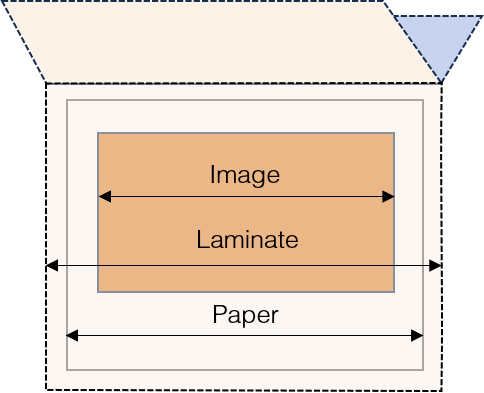
The top and bottom rolls should both be the same size and align perfectly to prevent damage to the laminator’s rollers. For high-quality encapsulation, the laminate rolls should be about 0.25 inches wider than the substrate.

LABELS AND FLEXIBLE PACKAGING
Because labels and flexible packaging can be produced using either thermal lamination or solventless lamination, there are more variations in film to substrate ratio.
Thermal Lamination
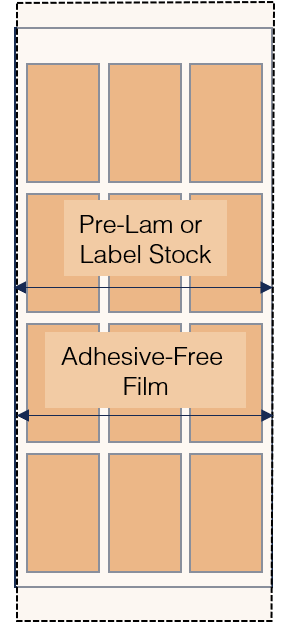
For thermal packaging, the layer that includes the thermal adhesive should always be narrower than the adhesive-free layer. For surface-printed pre-lams, this means that the thermal laminate layer should be narrower than the pre-lam.
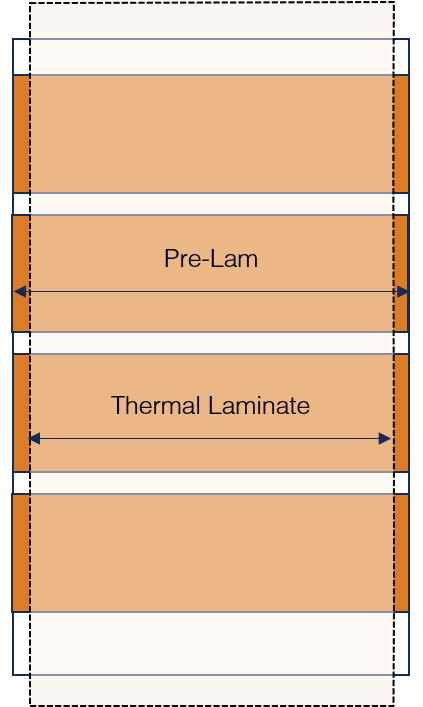

For converters who use a thermal pre-lam, such as StrataFlex™ Thermal Pre-Lams or EcoElement™ PE Thermal Sealants from Nobelus, the adhesive-free print web should be wider than the pre-lam.


Solventless Lamination
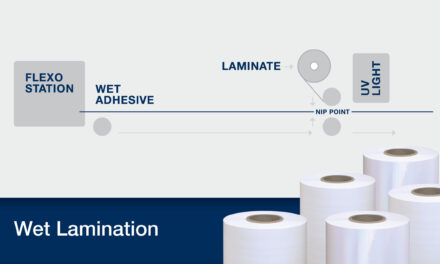
For wet lamination/solventless lamination, the print web should be the same width or narrower than the substrate but wider than the printed image.

WANT TO LEARN MORE LAMINATION TIPS?
Get in touch with us by phone or email with any lamination questions. Our in-house experts are always ready to help you find a solution and explore new possibilities in print finishing.